Today we will talk about a real trickster among the kaolinite-group minerals – halloysite.
Why is halloysite so tricky?
Identifying kaolinite-group minerals is no easy task. Halloysite is particularly insidious: it easily "hides" within a mass of kaolinite. Even methods such as X‑ray diffraction or infrared spectroscopy sometimes cannot identify it unequivocally.
A real example: Reynolds Cup 12 (2024)
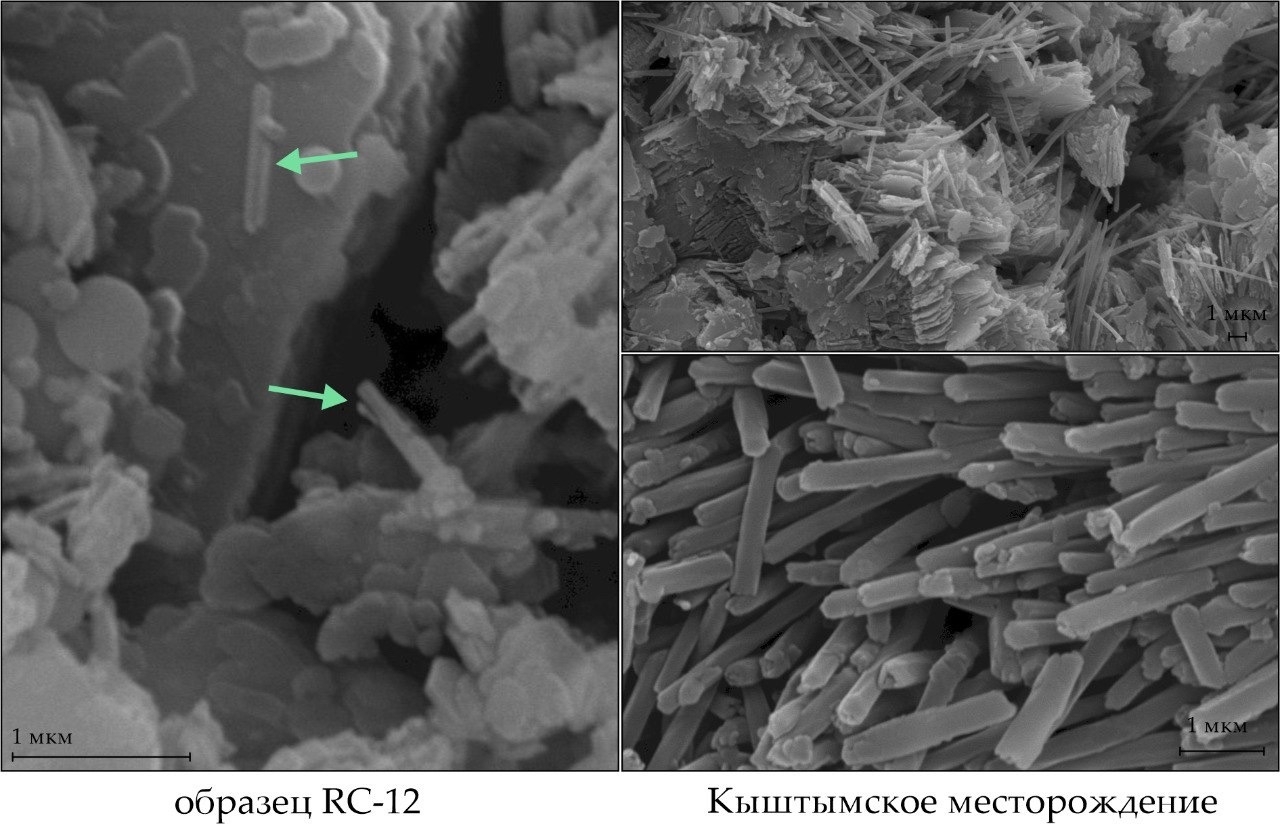
A striking demonstration of halloysite's "camouflage abilities" came from the Reynolds Cup 12 competition (2024). One sample contained a mixture of kaolinite with only 4% halloysite, which 65% of the competition participants did not detect. Although the proportion is small, it was possible to detect it – thanks to scanning electron microscopy (SEM). The SEM image clearly shows the characteristic halloysite tubes.
And in the "very tricky kaolinite" sample (from the Kyshtym deposit) provided by Irina Pavlova, a significant number of halloysite tubes were hiding beneath the mask of kaolinite (see images).
How can you find it?
To reliably identify halloysite, it is often necessary to combine methods:
The takeaway is this:
Not everything that looks like kaolinite is kaolinite.
The SEM images were taken by Mikhail Sergeevich Chernov, Candidate of Geological and Mineralogical Sciences (Lomonosov Moscow State University)
Why is halloysite so tricky?
Identifying kaolinite-group minerals is no easy task. Halloysite is particularly insidious: it easily "hides" within a mass of kaolinite. Even methods such as X‑ray diffraction or infrared spectroscopy sometimes cannot identify it unequivocally.
A real example: Reynolds Cup 12 (2024)
A striking demonstration of halloysite's "camouflage abilities" came from the Reynolds Cup 12 competition (2024). One sample contained a mixture of kaolinite with only 4% halloysite, which 65% of the competition participants did not detect. Although the proportion is small, it was possible to detect it – thanks to scanning electron microscopy (SEM). The SEM image clearly shows the characteristic halloysite tubes.
And in the "very tricky kaolinite" sample (from the Kyshtym deposit) provided by Irina Pavlova, a significant number of halloysite tubes were hiding beneath the mask of kaolinite (see images).
How can you find it?
To reliably identify halloysite, it is often necessary to combine methods:
- SEM – helps to see the morphology (characteristic nanotubes);
- Thermal analysis;
- X‑ray diffraction (XRD);
- IR spectroscopy.
The takeaway is this:
Not everything that looks like kaolinite is kaolinite.
The SEM images were taken by Mikhail Sergeevich Chernov, Candidate of Geological and Mineralogical Sciences (Lomonosov Moscow State University)