Dear Colleagues!
We present to you information about the workshops of the upcoming ICC-2025 conference in Dublin.
This year, ICC will feature four workshops/masterclasses to choose from. They will all take place on Sunday, July 13th. Tea/coffee breaks and lunch are included in the price. Details are provided below, including topics and speaker names.
We present to you information about the workshops of the upcoming ICC-2025 conference in Dublin.
This year, ICC will feature four workshops/masterclasses to choose from. They will all take place on Sunday, July 13th. Tea/coffee breaks and lunch are included in the price. Details are provided below, including topics and speaker names.
Workshop "Introduction to Key Analytical Methods in Clay Science"
The workshop will take place on Sunday, July 13th:
- Registration: 8:30-9:00
- Workshop: 9:00-17:00
Undoubtedly, X-ray diffraction, thermal methods, infrared spectroscopy, and electron microscopy can be considered key techniques that are widely used in research and industrial analysis of clays and clay materials. Moreover, in clay science, a multi-technique approach is often the only way to solve many research questions. This workshop is designed to introduce participants to four key techniques, each presented by an expert in the field. No prior knowledge is assumed, and the workshop will aim to provide a solid foundation for applying each of these techniques, covering the "pros and cons", as well as the strengths and weaknesses of each. Participants will have ample time to ask questions and benefit from expert advice.
Cost: €80 (VAT included)
Programme:
09:00—09:15 — Welcome
09:15—10:45 — X-ray Diffraction, identification and structure determination of clay minerals: An updated perspective
Speaker: Bruno Lanson, ISTerre, CNRS, Univ. Grenoble Alpes, France
The fine-grained and 2D nature of clay minerals and other layered compounds has led to the development of specific approaches for their identification and determination of their crystal structures using X-ray diffraction. This lecture will cover the basic concepts of such identification, including practical aspects of sample preparation and data collection. The main concepts of X-ray diffraction profile modelling will also be presented as a key tool for describing layered structures, including periodicity violations such as interstratification and stacking faults.
10:45—11:00 — Break
11:00—12:30 — Electron microscopy for clay studies: what can be done and what should be looked out for
Speaker: Toshihiro Kogure, Department of Earth and Planetary Science, Graduate School of Science, The University of Tokyo, Japan
Electron microscopy with resolution from micron to angstrom levels is a unique and important tool for investigating the morphology, structure, and composition of fine and heterogeneous clay particles. As is known, electron microscopes are divided into SEM and TEM/STEM, the choice depending on the sample form (bulk or thin film) to be observed. SEM resolution for surface observation is about 1 nm, and selecting the appropriate accelerating voltage is crucial when studying clay minerals. TEM/STEM can provide atomic-scale structural information on clay minerals using electron diffraction and so-called high-resolution TEM (HRTEM); however, electron beam damage must be carefully controlled. This lecture will present various examples of observation and analysis, highlighting key considerations for beginners using electron microscopy in clay science.
12:30—13:30 — Lunch
13:30—15:00 — Thermal analysis
Speaker: Katja Emmerich, Faculty of Civil Engineering, Geo- and Environmental Sciences, Karlsruhe Institute of Technology, Germany
Thermal analysis was one of the first analytical methods used to characterise clay minerals and has continued to evolve since then. Clay minerals and associated minerals and phases in soils and rocks undergo various thermal reactions (e.g., dehydration, dehydroxylation, oxidation, decomposition, recrystallisation, phase transition). Their characteristics provide information on the amount of mineral, its size and structure, even if it is turbostratically disordered, such as swelling clay minerals. Sensitivity is enhanced by the combined analysis of evolved gases. The lecture will provide a basic introduction to thermal analysis and the thermal reactions of clay components.
15:00—15:15 — Break
15:15—16:45 — Infrared spectroscopic methods for non-invasive clay studies
Speaker: Georgios Chryssikos, Institute of Theoretical and Physical Chemistry, National Hellenic Research Foundation, Greece
This lecture will discuss the application of Attenuated Total Reflection (ATR) in the mid-infrared and Diffuse Reflection in the near-infrared (NIR) for the study of clay minerals with minimal or no sample preparation. The aim is to isolate and study the spectrum of water and hydroxyls that adorn the internal and external surfaces of clays. Beyond mineral identification, these spectra allow determination of the octahedral sheet, termination of the tetrahedral sheet, layer charge, interlayer content, etc. Tips for proper sample measurement ranging from milligrams to tonnes, as well as effective band separation methods (including practical H/D exchange methods), will be presented.
16:45—17:00 — Closing remarks / Discussion
09:00—09:15 — Welcome
09:15—10:45 — X-ray Diffraction, identification and structure determination of clay minerals: An updated perspective
Speaker: Bruno Lanson, ISTerre, CNRS, Univ. Grenoble Alpes, France
The fine-grained and 2D nature of clay minerals and other layered compounds has led to the development of specific approaches for their identification and determination of their crystal structures using X-ray diffraction. This lecture will cover the basic concepts of such identification, including practical aspects of sample preparation and data collection. The main concepts of X-ray diffraction profile modelling will also be presented as a key tool for describing layered structures, including periodicity violations such as interstratification and stacking faults.
10:45—11:00 — Break
11:00—12:30 — Electron microscopy for clay studies: what can be done and what should be looked out for
Speaker: Toshihiro Kogure, Department of Earth and Planetary Science, Graduate School of Science, The University of Tokyo, Japan
Electron microscopy with resolution from micron to angstrom levels is a unique and important tool for investigating the morphology, structure, and composition of fine and heterogeneous clay particles. As is known, electron microscopes are divided into SEM and TEM/STEM, the choice depending on the sample form (bulk or thin film) to be observed. SEM resolution for surface observation is about 1 nm, and selecting the appropriate accelerating voltage is crucial when studying clay minerals. TEM/STEM can provide atomic-scale structural information on clay minerals using electron diffraction and so-called high-resolution TEM (HRTEM); however, electron beam damage must be carefully controlled. This lecture will present various examples of observation and analysis, highlighting key considerations for beginners using electron microscopy in clay science.
12:30—13:30 — Lunch
13:30—15:00 — Thermal analysis
Speaker: Katja Emmerich, Faculty of Civil Engineering, Geo- and Environmental Sciences, Karlsruhe Institute of Technology, Germany
Thermal analysis was one of the first analytical methods used to characterise clay minerals and has continued to evolve since then. Clay minerals and associated minerals and phases in soils and rocks undergo various thermal reactions (e.g., dehydration, dehydroxylation, oxidation, decomposition, recrystallisation, phase transition). Their characteristics provide information on the amount of mineral, its size and structure, even if it is turbostratically disordered, such as swelling clay minerals. Sensitivity is enhanced by the combined analysis of evolved gases. The lecture will provide a basic introduction to thermal analysis and the thermal reactions of clay components.
15:00—15:15 — Break
15:15—16:45 — Infrared spectroscopic methods for non-invasive clay studies
Speaker: Georgios Chryssikos, Institute of Theoretical and Physical Chemistry, National Hellenic Research Foundation, Greece
This lecture will discuss the application of Attenuated Total Reflection (ATR) in the mid-infrared and Diffuse Reflection in the near-infrared (NIR) for the study of clay minerals with minimal or no sample preparation. The aim is to isolate and study the spectrum of water and hydroxyls that adorn the internal and external surfaces of clays. Beyond mineral identification, these spectra allow determination of the octahedral sheet, termination of the tetrahedral sheet, layer charge, interlayer content, etc. Tips for proper sample measurement ranging from milligrams to tonnes, as well as effective band separation methods (including practical H/D exchange methods), will be presented.
16:45—17:00 — Closing remarks / Discussion
Workshop "ICDD® PDF-5+ и JADE® Pro"
The workshop will take place on Sunday, July 13th:
- Registration: 10:00-10:30
- Workshop: 10:30-16:00
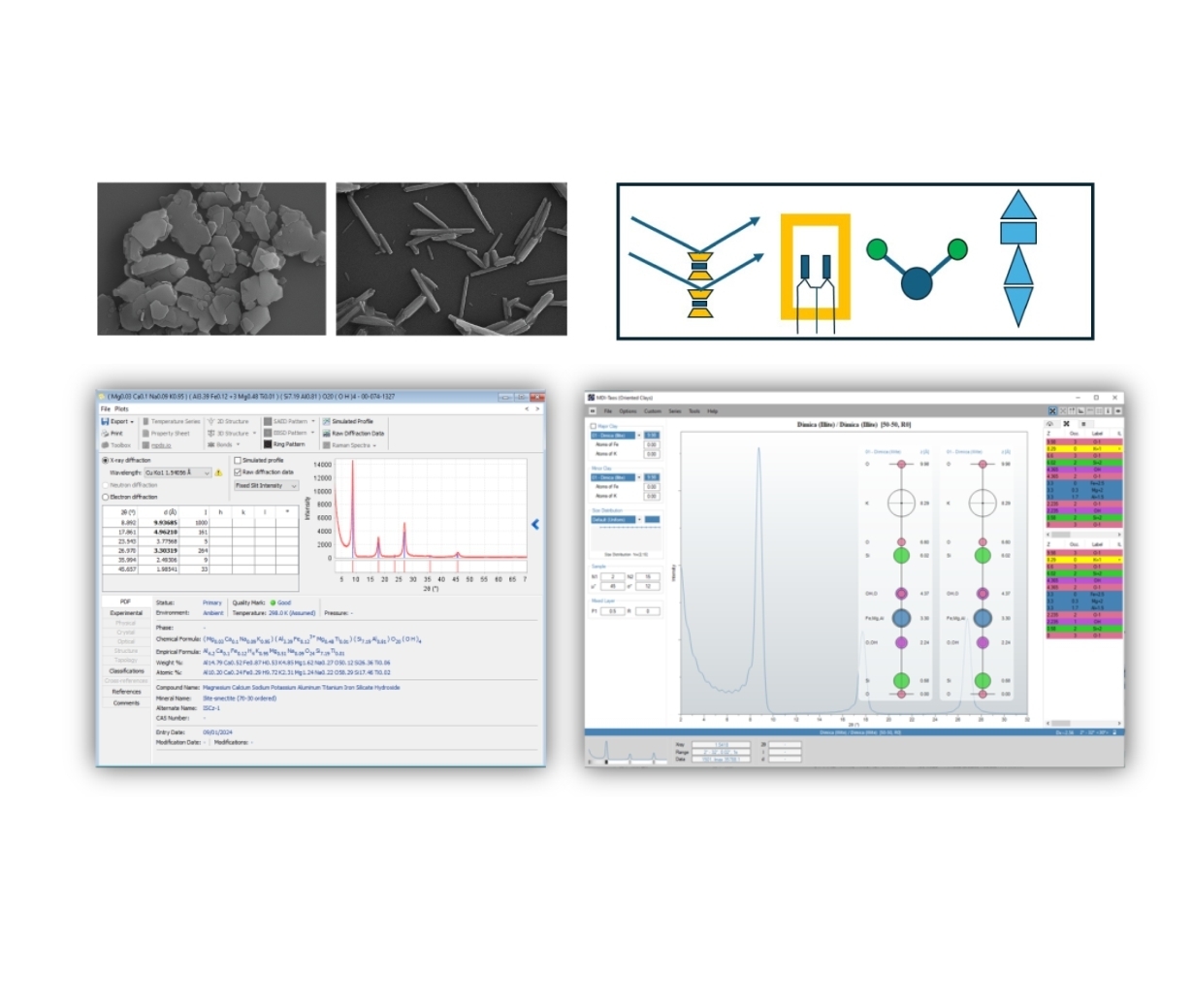
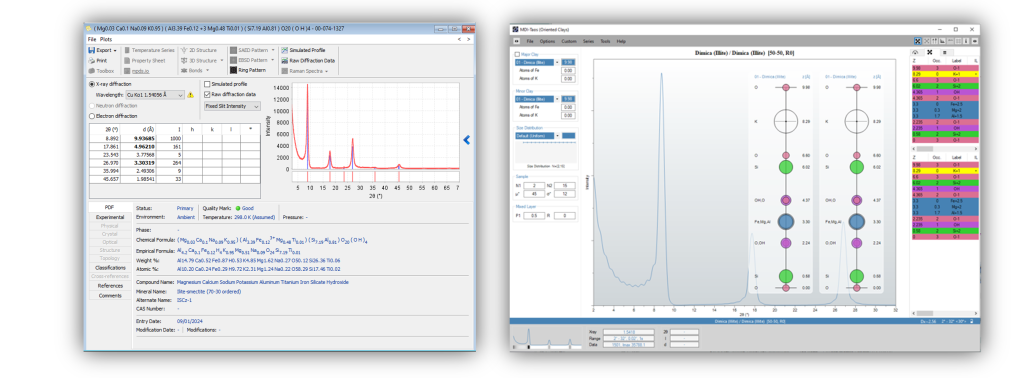
The first half of the workshop will introduce the Powder Diffraction File™ (PDF®) databases with an emphasis on clays and clay minerals. The second half of the workshop will cover qualitative and quantitative XRD analysis using JADE Pro software and clay modelling using JADE Pro Toolkit functions. Attendees will receive access to PDF-5+ and JADE Pro during the ICC meeting and for two weeks after.
Cost: €25, €10 for students (VAT included)
Key topics:
- Powder Diffraction File database entries
- Raw clay and mineral data entries
- Data searching
- Qualitative and quantitative phase analysis
- Modelling the diffraction pattern of oriented clays
Access to PDF-5+ and JADE Pro will be via a remote desktop server using web access. Attendees must bring their own laptops with wireless internet access (Edge, Chrome, Firefox).
Workshop "Kaolin, Kaolin and Kaolin — Everywhere"
Workshop leaders: Dr. Prakash B. Malla and Dr. Zhanna Percival
The workshop will take place on Sunday, July 13th:
- Registration: 8:30-9:00
- Workshop: 9:00-17:00
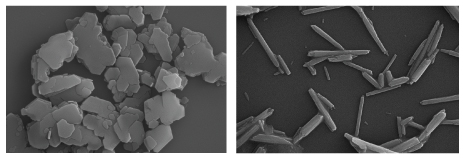
Kaolin is a widespread and most frequently used industrial clay mineral, which is integral to daily life due to its ubiquitous use in many commercial products. These include, among others, paper and paperboard, paints, plastics, ceramics, filters, fibreglass, rubber, inks, adhesives, high-performance cement/concrete, geopolymers, catalysts, and pharmaceuticals. Kaolin also plays an important role in many geochemical processes and environments, including soils. It is an important source of rare earth elements, which are essential for everyday high-tech, renewable energy and climate change, defence and national security.
Cost: €150 (VAT included)
Programme:
9:00—9:15 — Course Introduction
Speaker: Prakash Malla, Thiele Kaolin Company, USA
9:15—9:45 — Mineralogy of Genesis and Alteration
Speakers: Michelle Cheshire, Research Scientist, Chevron Corporation, USA; David Bish, Professor Emeritus, Earth and Atmospheric Sciences, Indiana University, USA
9:45—10:15 — Structure and Surface Chemistry
Speaker: Cliff Johnston, Professor of Soil Chemistry, Purdue University, USA
10:15—10:45 — Distinguishing Kaolin Group Minerals in the Lab and in the Field
Speaker: Zhanna Percival, Emeritus Scientist, Mineralogy Section, Northern Canada Division, Geological Survey of Canada, Natural Resources Canada, Government of Canada
10:45—11:00 — Break
11:00—11:30 — Adsorption, Retention and Removal of Metals and Organics by Kaolin in Soil
Speaker: Balwant Singh, Professor of Soil Chemistry, Sydney Institute of Agriculture, School of Life and Environmental Sciences, Sydney University, Australia
11:30—12:15 — Exploration, Mining and Beneficiation (Processing)
Speaker: Prakash Malla, Thiele Kaolin Company, USA
12:15—13:15 — Lunch
13:15—14:15 — Kaolin Uses and Applications
Speakers: Prakash Malla, Thiele Kaolin Company, USA; Murielle Perronnet, Ceramics Director – Science & Technology, Performance Minerals, Imerys, France
14:15—14:45 — Halloysite Deposits, Properties and Applications
Speaker: Serena Riela, Professor of Organic Chemistry, University of Catania, Italy
14:45—15:15 — Rare Earth Elements in Kaolin
Speakers: W. Crawford Elliott, Associate Professor, Geosciences and Chemistry, Georgia State University, USA; Prakash B. Malla, Thiele Kaolin Company, USA
15:15—15:30 — Break
15:30—16:00 — Kaolin in Nanotechnology – Preparation, Properties and Applications
Speakers: Gustave Kenne Dedzo, Department of Inorganic Chemistry, University of Yaoundé I, Cameroon; Jakub Matusik, Professor, AGH University of Science and Technology, Poland
16:00—16:30 — Modelling and Simulation of Kaolin
Speaker: Gonzalo R. Quezada Escalona, Research Assistant, Faculty of Engineering, University of Bío-Bío, Chile
16:30—17:00 — Valorisation of Kaolin Production Wastes
Speakers: Diba Ansar, Science and Technology Director, Imerys ITC, UK; Alex Newnes, Mining Technology Manager, Imerys, UK
17:00—17:15 — Closing remarks / Discussion
Workshop "Introduction to 1D Modelling of Clay Mineral X-ray Patterns"
The workshop will be led by Marek Szczerba, Christian Ufer, Dugald McCarty, and Jan Dietel.
The workshop will take place on Sunday, July 13th:
- Registration: 8:30-9:00
- Workshop: 9:00-17:00
The accurate identification of clay minerals requires detailed study of X-ray patterns that are intentionally shifted towards their diagnostic 00l reflections and are often recorded after a sequence of additional treatments, such as exposure to ethylene glycol or heating. Modelling these so-called "1D" patterns plays and will continue to play a very important role in the analysis process. This workshop will introduce two different programs that can be used to calculate 1D patterns of clay minerals, namely Sybilla and Profex-BGMN. The basic and important aspects of the calculation theory will be covered, but special emphasis will be placed on the practical application of these programs to calculate 1D patterns of pure and mixed-layer clay minerals for comparison with real examples.
Cost: €80 (VAT included)