Dear Colleagues!
In March 2026, the website of the Polish Mineralogical Society published a bulletin containing a text by Jan Środoń dedicated to memories of our departed colleague and friend V. A. Drits.
We express our sincere gratitude for this material, for the warm words and carefully preserved memories. This is very precious for all who knew and remember Victor Drits.
Jan Środoń in memory of Victor Anatolievich Drits
In March 2026, the website of the Polish Mineralogical Society published a bulletin containing a text by Jan Środoń dedicated to memories of our departed colleague and friend V. A. Drits.
We express our sincere gratitude for this material, for the warm words and carefully preserved memories. This is very precious for all who knew and remember Victor Drits.
Jan Środoń in memory of Victor Anatolievich Drits
On September 10, 2025, at the age of 93, two years after the death of his beloved wife Irina, Victor Anatolievich Drits passed away – an honorary member of our Society, one of the most outstanding clay mineral researchers in the world.
He was born in a village near Chita in Siberia, where his ancestors had been exiled in the 19th century for revolutionary activities. He began his scientific career at Irkutsk University. He studied physics, but after defending his master's thesis on quantitative X‑ray analysis of mineral mixtures, he became fascinated with mineralogy. He devoted his doctoral dissertation to clay minerals, including mixed‑layer minerals, which he was the first to identify on the territory of the former Soviet Union. After a conference in Lviv in 1957, where he presented his results, he received six job offers from various national research institutions, and in 1962 he chose the Institute of Geological Sciences of the Russian Academy of Sciences in Moscow, with which he remained associated almost until the end of his life. There he established the Laboratory of Mineralogical Research by Physical Methods, which for decades became a world‑leading centre of its kind. He mentored many outstanding researchers. He collaborated intensively with many scientists in Poland and abroad. He is the author or co‑author of more than 520 articles and eight monographs. With over 13,000 citations, he ranks second among Russian scientists in Earth Sciences (according to the ScholarGPS ranking, which includes only 186 of his English‑language articles). Besides clay minerals, he devoted much work to fine‑grained manganese and iron‑bearing minerals (collaboration with Grenoble). He also devised the structure and named charoite, a beautiful purple semi‑precious mineral from the Chara River in Siberia.
Victor Drits's connections with the Polish mineralogical community date back to 1978, when he accompanied Academician F. V. Chukhrov to the first Polish clay conference in Bolesławiec and presented a paper on the structure of muscovite‑phengite series micas.
In 1985, while working with Dennis Eberl at the US Geological Survey in Denver, I persuaded the organisers of the International Clay Conference in Denver to make an exception and fund the travel and participation of Victor Drits, a person then unknown to the American mineralogical community. After the conference, we organised a multi‑day trip for Victor Drits to southern Colorado and New Mexico, in which Professor Leszek Stoch also took part.
Thus, nascent friendly bonds grew into long‑term collaboration. From 1993 to 1997, we spent 2–3 months in Boulder, Colorado, in the home of Denny and Jo Eberl, jointly studying clay mineral crystallite sizes and developing methods for measuring these sizes. The undisputed leader of this group was Victor Drits, and the undersigned recalls this collaboration as the most exciting period of his scientific career. In 1999, Victor Drits took part in the EUROCLAY conference in Kraków. From 1998 to 2005, we collaborated for several months each year in Houston, Texas, in the mineralogy laboratory of Texaco (later Chevron), headed by Douglas McCarty. The work mainly concerned quantitative analysis of mineral mixtures using X‑ray and infrared methods, as well as calculating geophysical well parameters based on quantitative mineralogical and geochemical analysis of rocks.
Krzysztof Mystkowski, an exceptionally talented programmer and former PhD student of the undersigned, took part in this work. After 2005, in the same laboratory in Houston, and then in Kraków during a one‑year stay of Victor and Irina Drits in Poland, Victor collaborated with Arkadiusz Derkowski on the thermal dehydroxylation of clay minerals. Their last joint work was published in 2016. Victor worked in science until the end of his life; his last publication dates from 2025.
In my long life I have met many scientists from all over the world. Among them, Victor Drits was the most outstanding figure, both in terms of accumulated knowledge and the ability to apply it. He was also a man with a charming personality and broad horizons, so working with him was a great privilege and pleasure. We were friends for forty years and continued to correspond in the spring of 2025. I perceive his death as a personal loss, not to mention the loss to our discipline. But 'Non omnis moriar': Victor's enormous achievements will remain forever in science. May he rest in peace.
— Jan Środoń
You can read the original text of the bulletin on the website of the Polish Mineralogical Society via the link.
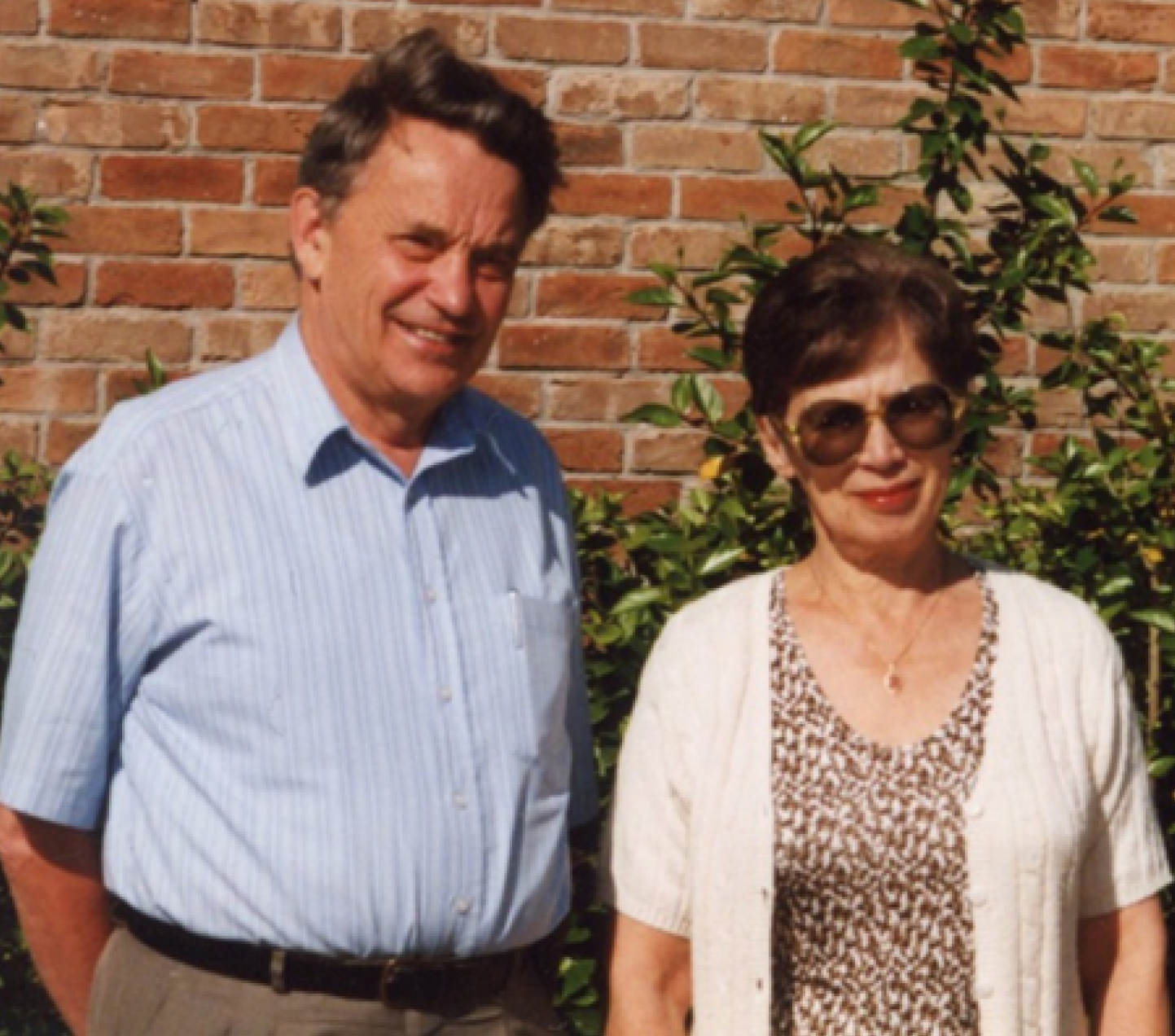
Victor Drits with his wife Irina (Houston, 1998)
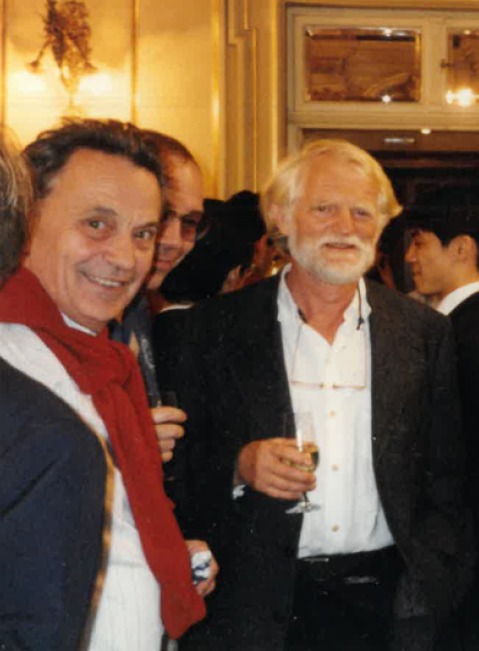
Victor Drits, Paul Nadeau and Dennis Eberl in the foyer of the Słowacki Theatre in Kraków, Euroclay, 1999